
Emanuele Barbella: Concerto in A major for solo violin, two violins, viola and bass (c. 1750?)
Emanuele Barbella
born 14 April 1718 in Naples
died 10 January 1777 in Naples
Premiere:
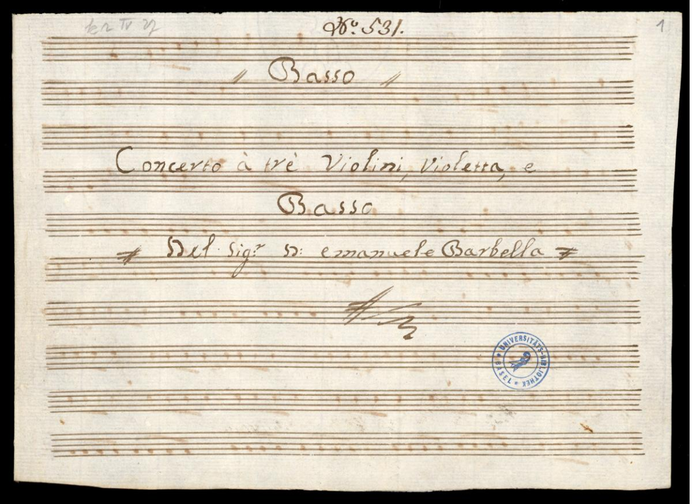
unknown, probably in Naples around the 1750s (indication: his opera buffa Elmira generosa was performed in 1753; the manuscript of the concerto in the University Library of Basel, which was
probably not written by Barbella, is dated 1760–99).
CD recording:
2024 by Gabriele Pro
It was not only Venice that was a hub for composing violin soloists (such as Albinoni, Vivaldi, Marcello, Lotti, and others) in the early 18th century, but Naples as well. The virtuoso
violinists of the Seicento (such as Gian Carlo Cailò, Pietro Marchitelli and others) were succeeded at the start of the Settecento by international virtuosos such as the widely travelled Angelo
Rigatti, Michele Mascitti and Francesco Barbella. His son, Emanuele Barbella, then belonged to the Neapolitan generation of violinist-composers who combined their Baroque roots with the emerging
galant style, thus becoming direct precursors of the so-called Viennese Classical period of Haydn and Mozart. Even if Naples’ reputation as a city of song and opera meant that Neapolitan
instrumental music was forgotten, this says nothing about its virtuosity and quality. On the contrary, as far as virtuosity is concerned, an anecdote handed down tells us that even Corelli,
during a visit to Naples in 1702, had to leave a difficult violin passage to the Neapolitan violinist Giuseppe Antonio Avitrano. Not least, the four conservatoires of Naples – originally social
institutions for orphans, later established as centres for musical training – produced outstanding instrumentalists who influenced the whole of Europe (Vienna, Paris, London).
Emanuele Barbella – encouraged by his father Francesco – also studied at one of Naples’ famous conservatoires, namely the Conservatorio di Santa Maria di Loreto. Emanuele Barbella is still known
today for his sonatas for mandolin. He himself became a teacher in Naples and a violinist both in the court orchestra and later at the Teatro San Carlo. As a composer, he is classified as an
early Classicist due to his simple yet thoroughly progressive violinistic style. It is, however, worth listening closely to discover pre-Paganini traits in his original violin solos.
Listen here: ((Violino napoletano ab 19:38)
Listening companion:
I. Allegro Comodo
The concerto begins, as resonant as a Vivaldi theme, in a full A major tutti, descending across all four strings, marked out forcefully by the basses. Elegant, dance-like motifs follow one another with striking loud-soft contrasts. But then there is a pause, and a restrained, syncopated second thematic section rushes forward in sixteenth notes until the solo of the violino principale begins and, in a triad with a rhythmic motif from the opening ritornello, immediately soars to the highest registers of the violin.
What follows are all the variations of late Baroque violinistic achievements, seeking nothing more than to evoke the listener’s delight in virtuoso violin brilliance. In runs up and down, with
rapid sixteenth-note figures and delicate double stops, the first and second thematic blocks are savoured with virtuosity.
Rhythmically, the violin drives forward with great variety towards a second tutti entry, which varies the second thematic block and prepares a new solo entry, equally brilliantly and
sonorously.
With long strokes across impressive pitches, the solo violin re-enters and flows into sixteenth-note run motifs. But then the violin increases its speed into virtuoso 32nd-note figurations
and drives its playing to virtuoso climaxes in several new bursts.
With motifs from the second thematic section, a fast tutti concludes this movement, which is effective for every soloist.
II. Largo
With a delicately woven theme, the strings open a serene Largo in E flat major, developing the theme both harmonically and melodically. And because it was so beautiful, the theme is repeated once
more after a brief pause.
The solo violin then re-enters with a cadenza, playing double stops, varying and improvising as if testing itself, before joining the other strings and the E-flat major theme with its own rapid
ornamentation.
Together, the theme is further developed; the solo violin contributes its double stops and figures and, at the end, improvises once more in a cadenza before the string ensemble is allowed to
conclude by returning to the theme in its original form.
III. Allegro
In the final movement – back in the main key – the pure A major sound is celebrated. This begins with the ritornello in the string tutti. A dotted ascending line and a descending run – slightly
faster than in the first movement – form its main elements. These are joined by forceful, chasing motifs that thematically expand the ritornello. Melodic phrases are presented with
grace.
The solo violin begins its solo brilliantly with the pure A major triad and soars upwards from it to the highest registers. This is followed by variations on striking violin figurations,
performed with virtuosity. Repetitive virtuoso flourishes are designed to impress the audience, as is fitting for a violin concerto.
The ensuing tutti begins in E major and momentarily falters. The solo violin also ventures into E major before returning to the brilliant A major via a sophisticated and varied interplay of
figures, and after a lengthy display of virtuosity, aims for beautiful, gallant melodic phrases.
After this second solo section, the string ensemble brings this brilliant Neapolitan violin concerto to a concise and natural close in the key of A major.