
Alun Hoddinott: Violin Concerto No. 2, Op. 153, “Le Mistral” (1994)
Alun Hoddinott
Born 11 August 1929 in Bargoed, Glamorganshire, Wales
Died 11 March 2008 in Morriston Hospital, Swansea
Premiere:
by Dong-Suk Kang (violin) at St. David's Hall, Cardiff on 6 June 1996.
Recording:
Dong-Suk Kang 1996 on YouTube, unfortunately still no CD release!
Alun Hoddinott, the most famous Welsh composer of the 20th century, was a pioneer in promoting contemporary music in Wales and throughout England. He was a professor of music at
University College Cardiff and, together with John Ogdon, co-founder and artistic director of the Cardiff Festival of 20th Century Music. A concert hall in Cardiff has been named after him: the
BBC Hoddinott Hall.
As a musician, he was first a violinist and violist. He composed his first violin concerto so that he could play it himself in an emergency. As a composer, he created over 300 works in all
genres and for a wide variety of purposes, including educational ones. After retiring from his professorship and organisational activities, he devoted himself exclusively to composing in his
later work. His style is described as modal serialism, meaning that his compositions were based on a serial series that was intended to characterise a work. In doing so, he always tried to remain
accessible to the ear. He conveys a sense of seamlessness and fluidity, especially in his sophisticated fusion of modality and serialism, according to musicologist Jeremy Huw Williams. In his
later works, Hoddinott obscures his solid technical foundations in favour of an obvious sense of spiritual exploration.
There is no official explanation from Alun Hoddinott himself as to why he named his second violin concerto ‘Le Mistral’. The French title refers to the well-known, powerful north wind of the
south – the mistral – which is often used as a metaphor for powerful, turbulent natural conditions. Hoddinott often spent his holidays in Provence. He was therefore just as familiar with natural
phenomena as he was with musical phenomena. From a musical point of view, Hoddinott may have chosen this name to symbolise the stormy, powerful or rapid atmosphere of his second violin concerto.
Christopher Painter, a personal friend of Alun Hoddinott and a composer himself, confirmed to me that "Le Mistral is directly influenced by the wind of the same name that
blows through the South of France." - and added: "As with many of Alun’s works, the music may not be descriptive
of the title, but is influenced by it, evoking the emotions that it stirred up in Alun’s mind."
Christopher Painter also wrote to me about the creation of the second violin concerto: "I recall Alun writing “Le Mistral” – I was his copyist at the time, and prepared both the score and orchestral material. As an accomplished violinist (he could have had a concert career had he wished to pursue that path), he spent a great deal of time in preparation and pre-composition. When writing the piece, he played through every passage multiple times to ensure that everything was not only playable but also fitted his musical plan. 'Le Mistral' is one of his major works, and it is a terrible shame that, to my knowledge, it has only received two performances."
Listen
here!
Listening companion:
I. Moderato - Presto - Moderato
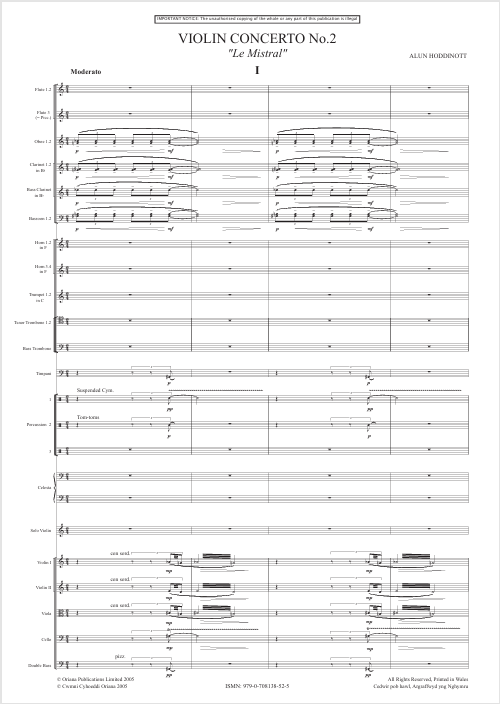
A gentle, swelling triplet motif in the woodwinds, rhythmically syncopated and accompanied by timpani beats, opens the concerto and is repeated several times. It is reminiscent of gentle
gusts of mistral wind, as suggested by the title of the concerto. These wind moments recur throughout the entire first movement, indeed throughout the entire concerto, and constitute its
fascinating uniqueness. The solo violin joins in and plays long, melodious up-and-down movements. A melodiously emphasised downward movement of the violin part leads to a short violin cadenza,
which is intercepted by the mistral motif in the brightest flute/celesta orchestration. Deep bass sounds then form a sound base for a sudden outburst from the violin and orchestra, before
returning to a longer interplay of violin movements and rhythmic orchestral motifs.
A contemplative, meditative violin solo is suddenly interrupted by violent mistral triplets, without these being able to prematurely interrupt the spreading violin meditation. Coming from the
highest heights, the violin plays its melody to a beautiful contemplative end and meditatively concludes the introduction to this concerto.
Two pairs of bell chimes, paired with violin pizzicatos, start the main movement of this violin concerto and trigger a frenzied presto solo on the violin, which, with its 6/16th note tempo and
accompanied by violent wind eruptions, becomes a kind of main theme for this first movement. An accented horn motif briefly interrupts the violin's frenzy. A brief fugato, begun by the low
strings in 6/16th frenzy, culminates in stormy bursts from the brass and timpani.
With delicate double stops, the solo violin counters this turmoil with a gentle up-and-down movement as a second theme. But the rumbling of the timpani and the recurring mistral motif do not
disappear. Nevertheless, the violin continues to sing its up-and-down melodies in higher registers, gradually calming the soundscape.
The transition to the development section is again marked by several bell/celesta pizzicato strokes. Now the various motifs mix in wild whirls. Alternating bursts of sound from percussion, wind
eruptions, melodious particles, mistral triplets and whirling frenzy alternate and become fascinating sound events, as if they were windy natural phenomena in Provence.
Clearly insistent and longer-lasting timpani strokes finally lead back to another violent eruption of the mistral theme (Moderato). The up-and-down theme also receives a kind of reprise in the
double stops of the solo violin. The sound eruptions calm down, allowing the violin to indulge in short free cadences. Melodious particles also sound peacefully in the orchestra, the mistral
motif has a peaceful effect and accompanies the well-being of the violin. What was stormy just a moment ago clears up into transparent, clear sounds. Another brief eruption is caught up again by
the familiar descending melody of the violin. The orchestral voices sing themselves out. The solo violin tires. The woodwinds finally play the peaceful final chord.
II. Vivo - Adagio - Presto
A double ‘gust of wind’ accompanied by the lingering sound of bells, followed by a string theme driven forward by dotted eighth notes, forms a new starting point for this concerto and opens the
second half.
This is followed by a longer, fascinatingly vibrating soundscape created by percussion (drums, tam-tam, etc.) and the whirring trills of the solo violin. Violent interjections from the wind
instruments are replaced by a melodious string phrase that forms a kind of second theme. It is accompanied by solo violin triplets and dotted eighth note interludes.
But soon the dotted wind bursts prevail and lead back to the previous vibrating soundscape and its constant shimmering movements. Despite violent drum rolls and timpani beats, the flow exhausts
itself and everything seems to calm down.
The celesta sounds into the calm. It is followed by a now more extended melodious string melody. But the dotted wind bursts return once more, then give way to an adagio.
This adagio is heralded by a celesta/glockenspiel, as if church bells had been set in motion by the wind. (See illustration) Then the solo violin begins to sing a song, surrounded by the clear
atmosphere of the accompanying orchestra. Woodwinds attempt to disrupt this atmosphere, but the solo violin and the enlightened atmosphere of the orchestra prevail against brief threats.
The celesta glockenspiel sounds again, heralding the return of the solo violin's song. The violin's singing develops further, sounding delicate above the bright orchestral sounds. The Adagio
fades away in a peaceful mood.
Then another atmospheric disturbance initiated by the percussion makes itself heard. Pizzicati and frenzied eighth-note movements bring back the frenzied whistling of the mistral from the first
movement. Once again, a sonorous dynamic is skilfully translated into music by the orchestra and solo violin. New gusts of wind can be associated with this. Wind bursts and virtuoso solo passages
blend together to create a crescendo that builds to an effective conclusion to this dynamically unique violin concerto.