
Fartein Valen: Violin Concerto (Fiolinkonsert) op. 37, 1939-40
Fartein Valen:
born August 25, 1887 in Stavanger, Norway,
died December 14, 1952 in Valevåg
Composition:
1939-40
Premiere: November 24, 1947,
by Ernst Glaser, violin
Recordings:
1949 Camilla Wicks, Filharmonisk selskaps orkester, Olvin Fjeldstad 2000 Arne Tellefsen, Oslo filharmoniske orkester, Christian
Eggen
2005-06 Elise Batnes, Stavanger symfoniorkester, Christian Eggen
“I was very fond of my cousin’s son, Arne. He strengthened my belief in my calling and made me realize that atonal music, although different, is no less natural than any other music, precisely at a time when I needed it most. One day, Arne was sitting on the roof of the outbuilding, singing atonally at the top of his lungs. I was in my bedroom making my bed when I heard him, and I thought that there could be no wrong in expressing what came so naturally from the mouth and heart of an innocent little child. For this reason, I was deeply saddened when Arne died of tuberculosis. On the night Arne died, I had the strong feeling that he was thinking of me. My grief was so great that I almost lost my interest in and joy of composing. Mrs. Dagny Knutsen Kristenson (who was the first person to perform my Piano Sonata No. 1, Op. 2) advised "I wanted to translate my thoughts and feelings about death into music, and that's how my Concerto for Violin and Orchestra came about." (quoted from Bjarne Kortsen, Fartein Valen. Life and Music, Diss. 1964, p. 398)
Fartein Valen was born in Stavanger, but as the son of missionary parents, he spent his early years in Madagascar. From 1906 to 1909, he studied at the Oslo Conservatory before moving to Berlin for the next four years, where he studied composition with Max Bruch. From 1927, he served for twelve years as music librarian at the University of Oslo. As a composer, Fartein Valen forged his own path in exploring a new musical language, becoming an independent composer who defies categorization, even though his Violin Concerto shares death as a theme with Alban Berg's Violin Concerto. His Violin Concerto in One Movement, along with a Piano Concerto and five symphonies, is among his most important works.
Listen here:
Arne Tellefsen (13.5 min)
Camilla Wicks (film 12.5 min)
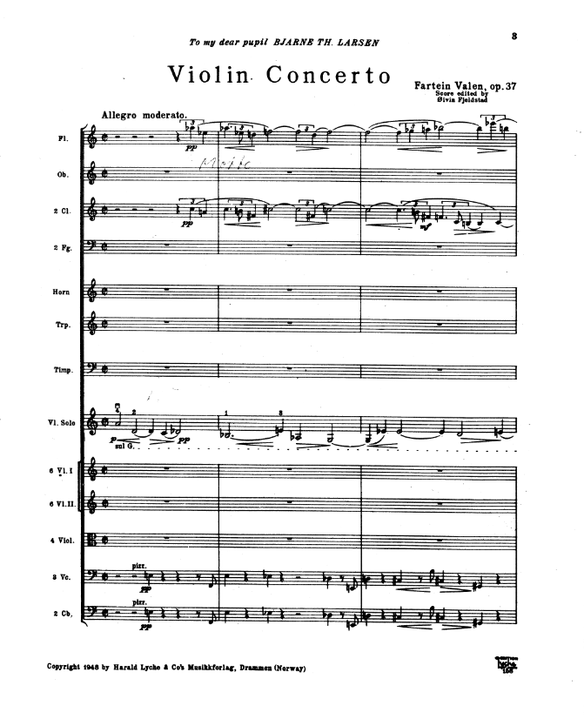
With a descending fifth, a melancholic twelve-tone melody enters allegro moderato in the solo
violin. Immediately, the flute and clarinet enter with a counter-theme. Following the violin theme, two phrases of this almost desolately beautiful melody can be discerned, which meditatively unfolds in the violin against all the dissonances of
reality. The second phase of the violin melody repeats the melody an octave higher. Listening more closely to the flutes and clarinets, one notices triplets whose restlessness disturbs the contemplative calm of the violin melody.
The basses accompany with rhythmically exciting pizzicati, mostly in a driving descending ninth figure. Then the cellos and bassoons take over the assertive opening theme with its descending fifth. A
violent agitation from the solo violin and orchestra is brought to a resigned end by double stops on the violin. Thus, in this exposition,
all the musical elements of this meditation on death and life are already present—albeit still hidden.
The secondary theme is introduced by the flute, followed—a fifth lower—by the clarinet. The secondary theme takes up the already
introduced triplet motif and develops it lyrically. The strings preface this lyrical theme with a lively, lilting motif.
The secondary theme is then taken up in a singing style by the solo violin, and later prominently by the solo horn. Descending pizzicatos are introduced. The lively, lilting motif asserts itself once more before the
music fades in the solo violin and the development section begins.
Now the violas enter, contrasted by the cellos' counter-theme, with the inversion of the melancholic opening melody. Canonically and
with a dense twelve-tone texture, the orchestral parts form the basis for the violin's subsequent free improvisation, whose theme originates from the counter-theme. The opening theme reappears in the first horn. At the end of the violin solo, the lilting,
dance-like, life-affirming theme reappears, first introduced by the woodwinds, then by the strings and the entire orchestra, building to a climax where the triplet motif appears in the trumpet
and upon the solo violin's re-entry.
Simultaneously with this new double-stop violin solo, the strings begin the reprise of the opening theme, which is immediately countered by the counter-theme in the winds.
But the potential of the themes and their motifs is far from exhausted, and further intensifications of the music follow.
Everything strives toward another climax, where the opening theme appears simultaneously in both its original form and its inversion.
The reprise of the secondary theme also begins again in the flute and is taken up by the horn. The lilting theme of renewed joie de
vivre lightens the character of this mournful music somewhat, almost gracefully. Then descending bass pizzicato passages propel the
music to renewed life. Almost like Bach, the more intensely (perhaps also the more often) one listens, the more details one hears in
this contrapuntally astonishingly diverse music. In the concluding section, "Meno mosso," the bassoon and horn once again emphasize
the melody with the opening fifth motif.
Then follows the short, ascending cadenza for the solo violin.
Chorale. Tranquillo
What follows is like a small miracle: As in Berg's Violin Concerto, the concerto culminates in a chorale, namely the Lutheran chorale "Jesus, meine Zuversicht" (Jesus, My Confidence), often used at funerals at that time. Unlike Berg, who adopted Bach's harmonization of the chorale (it is uncertain whether Valen was even familiar with Berg's concerto), Valen harmonizes the chorale contrapuntally with the various themes and motifs of the concerto so far. The chorale theme, played in a resonant D, now lends a deeper religious meaning to all the accompanying themes. The solo violin now plays the opening counter-theme as the connecting transitions between the chorale verses. Everything appears once again interwoven in the diverse musical material of this ebb-and-flow process of mourning.