
Henriette Bosmans: Concert Piece for Violin and Orchestra (1934)
Henriëtte Hilda Bosmans:
born 6 December 1895 in Amsterdam
died 2 July 1952 in Amsterdam
Premiere:
31 October 1935 by Louis Zimmerman and the Concertgebouw Orchestra conducted by Willem Mengelberg
Recordings (selection):
2025 Benjamin Nabarro
2024 Hyeyoon Park
1983 ? Vera Beths.
Before World War II and the occupation of the Netherlands, Henriette Bosmans was a successful up-and-coming pianist and composer whose works were included in the programmes of the
world-famous Concertgebouw Orchestra and performed by conductors such as Willem Mengelberg, Ernest Ansermet and Pierre Monteux.
When Nazi Germany occupied the country, she was banned from performing because she was half-Jewish. She had already suffered another blow in 1934 when her fiancé, the violinist Francis Koene
(concertmaster at the Dresden State Opera), with whom she performed and was engaged, died of a brain tumour. ‘I died a little bit then,’ she later said of this period, during which she composed
and published nothing until the end of the Second World War.
The premiere of the ‘Concertstuk voor viool en orkest’ was to be performed by Francis Koene, to whom the work was dedicated. After his untimely death, Louis Zimmerman and the Concertgebouw
Orchestra under the baton of Mengelberg took over the premiere.
The Concertstuk for violin and orchestra has an unusual formal structure, consisting of a rhapsodic sequence of changing themes and musical episodes, which requires repeated listening for a
more precise orientation. Although through-composed, it clearly comprises three parts, thus reminiscent of the traditional concert form.
Listen here!
Listening companion:
Part 1
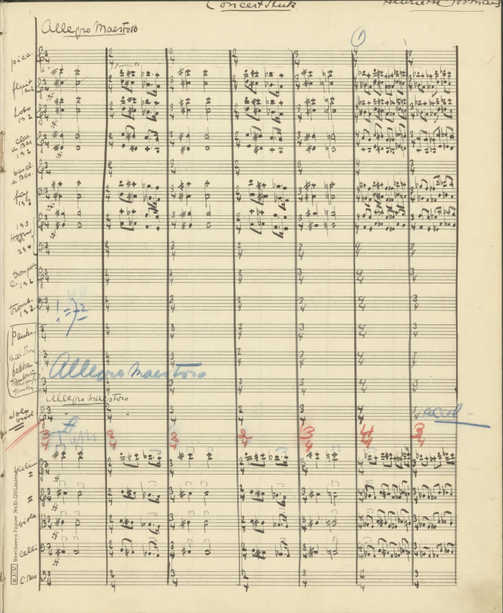
With a sad and poignant unison theme, the full orchestra makes an expressive statement, entitled Allegro maestoso. A repeated augmented second immediately evokes echoes of Oriental-Jewish music.
The theme pushes forward and then, with the full force of the timpani, asserts itself once more before retreating to allow the solo violin to enter softly and cautiously.
Pianissimo, the solo violin begins a recitative on the high D flat, which descends plaintively to a long middle G. A violin cadenza then leads to a cheerful, dance-like allegro theme in the
woodwinds, which is taken up by the solo violin in double stops and rhapsodically defended against the orchestra's anti-motifs.
First in the brass, then in the solo violin, a slow, plaintive three-note motif sounds in a new episode, which the violin develops further and leads into a contemplative phase.
The orchestra takes up this theme broadly and dramatically intensifies the music to a powerful climax with strong timpani, which leads into a solo episode for the violin in which the declamatory,
oriental-coloured opening theme of the work is dramatically repeated in octave chords. Above this, the dance-like woodwind theme reappears and mingles with the rhapsodic three-note vocal theme of
the violin.
Virtuoso playing and double stops on the violin, together with the orchestra, infuse the music with new energy and new drumbeats – più vivo and con fuoco – before a calming effect sets in and the
woodwinds and solo violin slowly transition into an adagio section.
Part 2
From this transition, the flutes take up a gently descending four-note motif at the beginning. From this, the solo violin develops its adagio theme: a gently rocking melody that, together with
the flutes, opens up a wide lyrical space.
Darker colours from the orchestra are added. Above this, the solo violin continues to spin its adagio theme in the high register. After pulsating drumbeats, the music accelerates. A horn calls
out in between, but the violin continues to play its lyrical meditation as if in a trance.
After the violin introduces an oriental-sounding turn – several times in different registers – the orchestra increasingly supplants the violin and intervenes in an increasingly threatening
manner, with violent drumbeats becoming noticeable and the brass instruments howling briefly.
But the flutes (with the oriental-sounding turn) and the solo violin find their way back into their wide meditative space. An expressive cadenza by the violin finally leads to the third section
of this concert piece via a timpani roll.
Part 3
A rhythmically rousing Allegro molto theme, first introduced by the orchestra, is taken up and continued by the solo violin. Accompanied by violent orchestral beats, the violin leads a lively and
varied dance.
After a certain fatigue from the constant forward thrust of the violin and orchestra, a moment of quiet contemplation follows. The violin recalls the lyrical sounds of the adagio section.
After a horn call, the violin resumes the wild momentum of the music and surprisingly leads to a repetition of the first dramatic orchestral melody from the beginning, which now seems almost
desperate.
The solo violin, however, sticks to its lively dance theme and wants to lead the music to a brilliant conclusion. The end, however, is once again dominated by a strangely warning unison
motif.