
Sauli Zinovjev: World Bearer. Violin Concerto No 2 (2025)
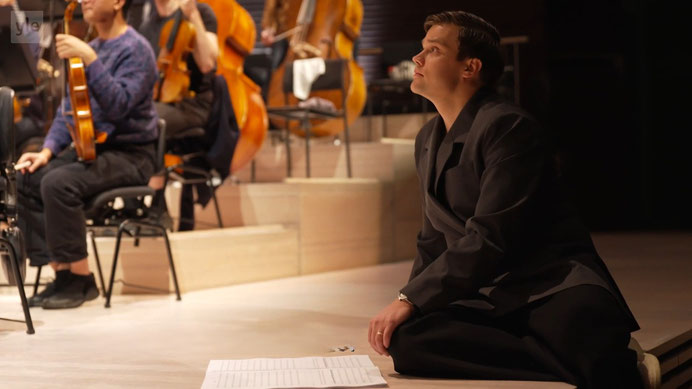
Sauli Zinovjev
born in 1988 in Lahti, Finland
Premiere:
10 October 2025 by Nikita Boriso-Glebsky, violin, and the Finnish Radio Symphony Orchestra conducted by Elim Chan
Recording:
YouTube
What carries the world? The subtitle of this latest violin concerto by young Finnish composer Sauli Zinovjev (born in 1988), which premiered in October 2025, arouses curiosity. Philosophical
answers are not to be expected, but fundamentally new emotions certainly are. Zinovjev is one of the rising musicians from Finland who are currently shaking up the classical music scene (the most
prominent representative at the moment being conductor Klaus Mäkelä). Zinovjev's artistic statement is:
‘Emotions are everything. Dramaturgy and textures form an unstoppable journey that develops like an inexorable force of nature, like life itself. This is the space I want to create for other
people in my art, so that they can visit it and pass on the experience from person to person.’
What shaped his biography was his switch from rock guitar to composition and his studies at the Sibelius Academy in Helsinki and with Wolfgang Rihm in Karlsruhe from 2010 to 2015. He sets
himself extremely high standards as an artist: ‘When I compose, I exercise godlike control by placing every particle of the composition exactly where it belongs. There are no rules. The only
guiding star is my integrity towards myself.’
Music communicates with the listener in its own unique way. Titles for the individual movements, as in this violin concerto, help to get you on track, but all listeners must follow the path
of listening themselves. Only then will listeners be emotionally touched in their own selves by the novel, colourful and energetically charged sounds conveyed by the composer. The following
listening guide is the transcript of my first listening experience of this recently premiered violin concerto.
The movement titles are:
I. Ritual
II. Tempest
III. I Am The Ghost, I Am The Spirit
IV. Between Worlds
V. Broken Glass
Listen here!
Listening companion:
I. Ritual
The title Ritual refers to religion or art. Ritual means: a cultic or artistic performance following prescribed rules refers to something deeper in life.
A high, noisy flageolet tone from the violin sets a minimalist, defining rhythm, sweeping the orchestra's string ensemble along with it and building the musical action to an orchestral sound
impulse. The solo violin immediately continues with arpeggios, the orchestra strings arpeggiate along with it and repeat the tonal sound impulse. The solo violin begins again, this time with a
glissando on the high G side, quietly accompanied by the orchestra's string sound. With a rocking bow and pizzicato plucking, the solo violin launches into a virtuoso rhythmic block over several
bars, strikingly supported by the orchestra. This drive is interrupted only briefly by a tremolo on the low G of the violin, before immediately returning to the rhythmic momentum of this block
thanks to the violinist's virtuosity and the orchestra's insistence.
A soothing melody allows the violin to sing above the rhythmically agitated orchestra, serving as a kind of secondary theme. With an insistent, repetitive motif, first in the woodwinds,
then in the brass, the orchestra presses in from the background, pushing the violin melodies upwards.
The violin starts again and leads back to the minimalist opening rhythm. Violent interjections from the orchestra accompany it. Once again, the soothing melody reappears in the solo violin amid
all the forward momentum. But a dissonant clarinet solo, supported by the bass clarinet, startles the listener. Timpani beats cause the orchestra to freeze briefly, only the violin persists with
its initial noisy flageolet tones. Against a dark sound backdrop, the violin plays wildly, as if for its life. The timpani beats remain threatening, the violin plays against them. Chaotic
dissonances disrupt the ritual.
Only when the high drums reintroduce the minimalist opening rhythm of this ritual does relaxation set in. The solo violin joins in with the familiar rhythm, leading to a liberating
interlude.
The violin immediately finds space to briefly open a glissando melody phase. But the opening rhythm reasserts itself in the drums and wind instruments. The violin is carried away, unable to
prevent itself from escaping back into its wild melodic attempts. But the orchestra dominates more and more, trumpets and later high flutes provide the rhythmic impulses, and the violin is
increasingly caught up in the breathless maelstrom of its own virtuosity. The ritual is complete and breaks off.
II. Tempest
Almost self-explanatory after just a few moments of listening: the title of the movement is Storm, and it continues directly from the first movement in terms of dynamics and violinistic energy.
The violin immediately rushes off, brass bursts supporting the swirling air currents. In the context of a violin concerto, one is immediately reminded of Vivaldi's Storm in his Four
Seasons. And at times, one thinks one hears Vivaldi being quoted.
In any case, in the middle section of this movement, the storm subsides into a kind of cadenza for the solo violin, which duets with the solo flute. Until the storm returns.
It is a pleasure to listen to the artistry of being able to hear a storm in contemporary music in such a uniquely unadulterated way. Natural emotion unadulterated in a new musical guise.
III. I Am The Ghost, I Am The Spirit
The title of the movement now leads us to think of the human spirit after the natural phenomenon of the storm. From the harshness of nature, we move on to the refinement of the spirit. The slow
movement follows.
And it begins as a contrast to what has gone before: calm spreads through sound and melody. Here, too, it is elemental, human consciousness in a state of rest. One follows the violin pensively
over calm orchestral soundscapes until a bassoon emerges from the dark orchestral sound, rises and elicits new bell-like sounds.
At a climax, the orchestra begins again with beautiful tones and the violin is inspired to new melodic twists and turns. After a harp solo, the beauty of the sound increases even more, with the
violin musing ever higher on its melodies.
Everything strives towards a final climax, carried by the trombones, before almost immediately trickling down into string glissandi, then harp and flute. The violin remains alone – and falls
silent.
IV. Between Worlds
The solo violin, which is called for again, is accompanied right from the start by woodwinds and the harp. It has to find its way through different soundscapes. An oboe briefly emerges as the
violin's partner, followed by a clarinet, but all within the soundscapes of the strings and woodwinds, with the strings opening up yet another soundscape with a pizzicato accompaniment. The
violin enters this pizzicato world, accompanied only by the first violinist in a dance-like pizzicato pas de deux.
A double-stop passage by the solo violin creates a new soundscape into which the orchestra blends. Ascending double stops gradually build up a suspenseful passage that ends in the supporting
world of a brass harmony.
V. Broken Glass
Directly attacca, the solo violin begins to virtuosically construct a minimalist soundscape, whose tension increases and increases thanks to the violinist's super energy, until it is taken up by
the full orchestra, dominated by trombones and trumpets. The trombones repeatedly play a short motif that continues the drive of the music and propels the solo violin to energetic high
notes.
Only when the initial energy has slowly dissipated does the violin find the opportunity to present its previously restrained melodic ideas in a short dialogue with the flute over a wide variety
of crystalline and dark orchestral colours.
But once again, the violin begins with its minimalist-inspired soundscape, and the orchestra helps to rebuild it. Once again, the brass instruments introduce their short motif and recharge the
musical energy soundscape. A horn fanfare marks the end of this dynamically intensified development.
Once again, the musical soundscape runs out of energy, exhausting itself until the violin infuses it with new energy with its virtuoso, minimalist violin sounds.
Thumping from below, the energy recharges. The violin becomes driven. But then the sound becomes increasingly overwrought. Trombone dissonances break in, grinding sounds overlay everything, as if
the music were walking over broken glass. These grinding orchestral harmonies drive towards a vehement conclusion.