
Steve Elcock: Violin Concerto op. 13 (ca.1996 - 2003; rev. Oct. 2020)
Steve Elcock
born 13 July 1957 in Chesterfield, Derbyshire, England
World premiere
World premiere in Bourg-en-Bresse in 2004 by the amateur orchestra OBPA, conductor Steve Elcock, soloist Eric Filippi.
CD recording
2022 by Zoë Beyers, violin, and the English Symphony Orchestra, conductor: Kenneth Woods
A language teacher from England in France has been composing self-taught symphonic music in the tradition of Nordic symphonic music for years. A phenomenon that has already resulted in 10
symphonies. This Steve Elcock only became known beyond his inner circle of private friends less than 10 years ago, when his 3rd Symphony was recorded for a CD and received great attention from
music critics. Further recordings of his music were made, including his violin concerto, which was released on CD in 2024 after various stages of development and is notable for its energy and
special symphonic sound aesthetic. It speaks an independent language and continues the tradition of violin concertos in an original way, perhaps precisely because it was written without taking
into account the various established musical trends of our time. At a time when contemporary music in particular is seeking new paths, it should certainly be recognised and performed in many
places in the spirit of a diverse postmodernism.
Steve Elcock commented on his violin concerto as follows:
"I began this concerto in 1996 or thereabouts. For a long time there was just the first movement, and it was originally
scored for strings alone. After the slow movement there was another long gap till I got round to the finale in 2006, prompted by the fact that we were going to perform it with my amateur
orchestra.
With the first movement, I wanted to achieve a return to the classical momentum that had largely been lost thoughout the Romantic era and onward. The energy is unflagging, verging on the desperate, relief being provided only by the two appearances of the expansive second theme; but even this is underpinned by a niggling rhythm in the violas, deriving from a typical piece of sarcastic nastiness into which the various elements making up the first subject have coalesced.
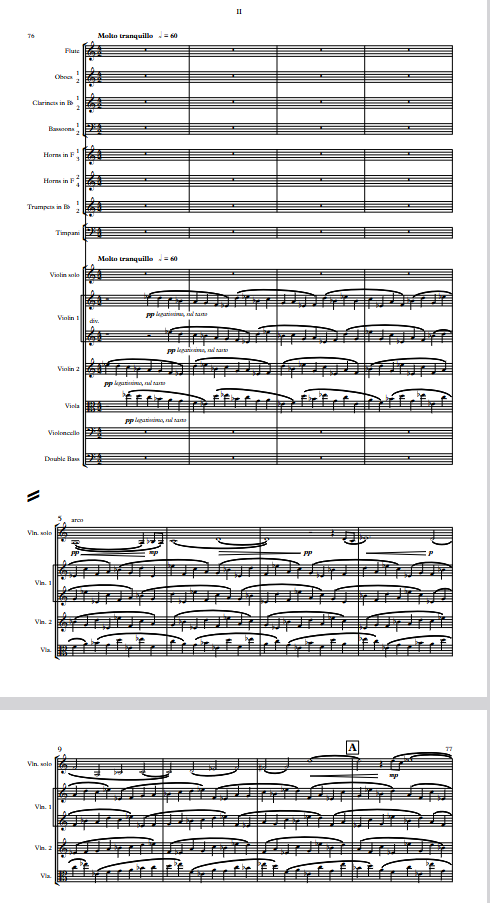
The second movement provides a welcome contrast. Its opening makes use of change-ringing techniques applied to slowly moving scales in violins and violas (the first time I had tried this), evoking distance bells ringing across a valley.The first subject material is developped by the soloist against this background, ultimately arriving at a second idea marked "Pavane". The development is mainly concerned with the first subject material, leading to a return of the pavane in the highest register of the violin against chiming oboes and violins (the scales have acquired a dotted rhythm during the development) - a very strange sound, this. When everything is suddenly cranked up a tone into a radiant D major, the music becomes almost tearfully joyous for a while, before gradually fading away, the distant bells reluctantly ceasing their ringing.
The short finale is a passacaglia incorporating a gradual accelerando from andante to presto. It culminates in a severely logical rendering of the passacaglia theme as a duet for the unusual combination of solo violin and timpani."
Listen here:
Listening companion:
I. Allegro vivo
The orchestra and listeners are energised in one fell swoop. Syncopations in the basses, wild horn blasts and woodwind rhythms form a mixture of energy to which the solo violin immediately
contributes with rhythmic sextuplet figurations. Until one can really orientate oneself, the solo violin overpowers this driving field of energy with a high rhythmic syncopated theme that gives
the whole movement a constant drive. Horn calls, further figurations and the syncopated theme in the violins push on, the solo violin once again ascends to its syncopated theme and drives the
wild energy drive forward. Only after a brief lull in the orchestra does the violin section of the orchestra take over the syncopated melody in full sound, which again encourages the solo violin
to respond with an energetic double-stopping drive forward.
The bassoons in the orchestra introduce a second thematic group, which gives the solo violin the opportunity to sing out a cantabile, finely spun bow melody, while in the accompaniment the
orchestral strings only slightly moderate their continuous drive. The violin solos are accompanied by cantabile horn melodies.
After this somewhat calmer phase, the rhythmic syncopated theme in the solo violin returns from the background. After a horn outburst and timpani strokes, the strings begin a kind of
development section with a striking introduction. Sound interjections and rhythmically twitching figurations from the orchestral instruments follow one another. The solo violin also joins in with
its solo contributions to these twitching figurations, while the high woodwinds add glistening melodic arcs.
After a horn outburst concluding this phase (‘subito tranquillo’), a melodically calm, ascending solo by the violin brings some contemplation. The violin can luxuriate in the highest notes for a
while, but heavy orchestral voices and timpani begin to interfere. Dark tones turn against the passionately playing solo violin, everything pushes towards increasing confusion, the composer even
speaks of sarcastic malice that the diabolical confusion wants to cause.
Finally, the solo violin with its sextuplet figurations confronts all the confusion and leads back to the syncopated theme, which is then immediately supported by the horn calls. The energy field
of the opening, which continues to push forward, is reprised.
The second thematic group also returns, introduced by the violin's dark register, accompanied by the horn instead of the bassoon. The violin cantabile carries its melody upwards, which is then
taken over by the high woodwinds and counterpointed by horn melodies until the violin continues the melody in a voluptuous manner.
As before the development section, the strings mark the transition, now to the final coda, which is characterised by the same continuous energy as in the entire movement, by fierce horn calls,
flute glissandi and rhythmic penetrance. Everything drives towards a wild drumbeat ending.
II. Molto tranquillo
Violin bell sounds (i.e. slowly moving scales in the violins and violas) open up an imaginary wide space. In it, the violin darkly sketches a wide melody characterised by quaver suggestions,
which soon escapes into filigree heights. A clarinet counterpoints the violin melody from a dark sound background.
From the depths, cellos and double basses provide a melodious response to the violin's continuous singing. As other orchestral instruments join in, the imaginary landscape expands in all
directions of sound.
A timpani roll interrupts this soundscape, with the wind instruments forming first. The violin becomes agitated, but then leads into a dark, melancholy pavane in the violas' song. In the
development section, new registers of sound open up around the melody of the first theme, creating an imaginary melodic space all of its own, which is continually inspired, built up and filled by
the solo violin (and especially by horn sounds).
After a few excited violin runs, bass pizzicati finally bring some structure and orientating rhythm to this melodic soundscape. Above this, the violin plays the reprise of the Pavane theme at the
highest pitch. The whole orchestra takes over the Pavane theme once again, now in radiant D major, and the violin accelerates its figurations. More and more, however, everything fades into an
imaginary distance. The dark melody from the beginning emerges once again, along with repeated memories of the Pavane theme. Everything melts away like a watercolour. Woodwind sounds fade away
iridescently, and finally only a few last violin sounds remain.
III. Passacaglia. Andante – Moderato – Più allegro – Allegro vivace – Subito presto – a tempo, minacciando – Allegro molto – Adagio – Più adagio – Ancora meno mosso
Under a high flute sound, the passacaglia theme immediately presents itself as an ascending and descending scale in the basses. Above this, the upper voices of the woodwinds and strings begin their upward scale, overlaying the basses. A trumpet signal, as if from afar, together with the timpani, brings us back from the beautiful imaginary world of the second movement. The bassoons, clarinets and violas follow unimpressed with the ascending passacaglia theme, before the solo violin makes its contribution to the passacaglia hidden in double stops.
However, any memory of the second movement is dispelled by the trumpet signal, which drives the violin accellerando to a fast, rhythmically characterised, energetic theme. The passacaglia theme - as befits a passacaglia - remains present throughout, both in the solo violin and in the orchestral winds, and can be heard again and again.
After a lengthy solo violin introduction, a melodious second theme appears in the violin, under which the passacaglia theme is transformed into an original upward accompaniment. The transformations of the passacaglia theme accelerate more and more. Finally, the high flute dialogues back and forth with the violin.
After a timpani signal, the movement of the music calms down. The solo violin takes on a plaintive and confused quality. Only after a violent tuba signal do the passacaglia elements in the solo and orchestra accelerate again and are reminiscent of the first movement in their energy. The relatively short and then wildly intensifying finale ‘culminates in a strictly logical rendition of the passacaglia theme as a duet for the unusual combination of solo violin and timpani.’ (Steve Elcock)