
Toshi Ichiyanagi: Double Concerto for Violin, Shamisen and Orchestra (2021)
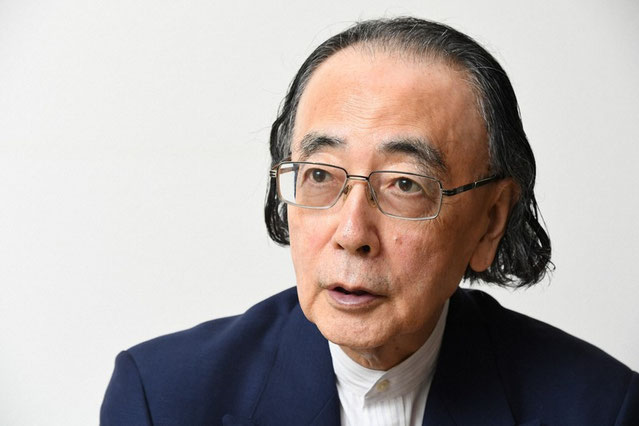
Toshi Ichiyanagi
born 4 February 1933 in Kobe, Japan
died 7 October 2022 in Tokyo, Japan
World premiere:
25 October 2022 in Tokyo with Tatsuki Narita, violin, and Hidejiro Honjoh, shamisen, Yomiuri Nippon Symphony Orchestra, conducted by Sylvain Cambreling
CD recording:
2023 with Mayumi Kanagawa, violin, and Hidejiro Honjoh, shamisen, on NEOS
Toshi Ichiyanagi was one of a group of Japanese composers who combined European experimental music with a fresh perspective on their own Japanese musical tradition, alongside internationally renowned composers such as Toru Takemitsu (1930–1996), Somei Satho (1947), Toshio Hosokawa (b. 1955) and Dai Fujikura (1977).
It was not enough for these Japanese composers simply to adopt Japanese folk tunes and combine them with Western symphonic music. They sought a third way that would unite the contemporary developmental trends of Western music with their own search for identity.
Toshi Ichiyanagi came from a Christian family in Kobe. Both his father (a cellist by profession) and his mother were involved in European art music. At the age of 19, Ichiyanagi moved to New
York to study at the Juilliard School of Music. There he met John Cage, who challenged him to develop his own experimental musical language. He made a name for himself in the international
avant-garde scene of the time: in New York at Yoko Ono’s ‘Studio’ on Chambers Street and at George Maciunas’ ‘AG Gallery’, at the Kammerspiele in Düsseldorf during the ‘NEO-DADA in Music’
festival (June 1962), and also at the International Summer Courses in Darmstadt. During this period (1957–63), he was married to Yoko Ono, who later became John Lennon’s wife.
On his return to Japan, he introduced John Cage to the Japanese public. In his search for beauty and his own identity, he lived and composed prolifically, constantly evolving his
style. From Cage and his radical aleatoric music, he moved through Fluxus and electronic music to minimalism, which he developed into his own Japanese version in the early 1970s. His repetitive
minimalism was shaped by an Eastern conception of time, which sought to experience time as circular rather than linear, in which one constantly perceives the present moment and closely links time
to the length of a human breath. This resulted in a flexibility of time and tempo in Ichiyanagi’s music: slower and faster passages merge into one another, as is also the case in traditional
Japanese music.
Toshi Ichiyanagi leaves behind a diverse body of work spanning all his compositional phases, including a violin concerto entitled ‘Circulating Scenery’. The double concerto for
violin, shamisen (long-necked lute) and orchestra highlighted here is Ichiyanagi’s final composition, which he completed at the age of 89 shortly before his death. The two instruments symbolise
the two worlds and musical languages which, together with a string and four-piece percussion ensemble, form a novel, mutually enriching sonic experience. At the end of an avant-garde and
experimental compositional career, a mature, modest intercultural work of art with its own distinct identity emerged.
The only thing available to listen to is the NEOS CD!
Listening companion:
I
From a shy, high G at the beginning, the solo violin forms a simple, melodious motif, which concludes with three pizzicati on the low G string and is repeated – slightly altered. Following this
first tentative approach by the violin, the shamisen responds with its plucked, non-tempered tones in an equally respectful manner. Only now do the orchestra’s lower strings – restrained yet
melodious – accompany this mutual, unpretentious and modest approach between the two instrumental soundscapes. As the string accompaniment recedes once more, the two instruments play a solo
double cadenza, whose distinctive blend of sounds and rhythmic phrasing leaves a lasting impression.
A forte ascending violin gesture – supported by pizzicati from the strings – is answered by the shamisen with rapid, joyful sixteenth notes. The violin imitates them softly on its E string.
Later, the shamisen takes over the ascending forte gesture; indeed, the two instruments take their time to play off each other’s idiosyncrasies.
After the orchestral violas give new impetus to the dialogue between the two instruments with two chords and a melody of their own, the shamisen launches into a solo passage of a special kind.
The orchestra supports this with rapid pizzicatos. Then the violin and shamisen lead into an orchestral interlude that takes up the ascending forte gesture. In addition, a percussion section now
joins the strings; the marimba and cymbals mark the orchestra’s surge with their chords. A xylophone joins in. The basses drive the music forward. Shamisen sounds and violin octaves blend in. A
repetitive descending bass motif drives the music forward, then the orchestral outburst slowly subsides, and the gong sounds twice. The low strings descend slowly, accompanied by marimba tones.
Finally, the shamisen plays its last meditative chords. With a high, melodious double-stop sound of D flat/B on the solo violin, accompanied by the bass, this subtle East-West musical encounter
comes to a peaceful close.
II
Against a background of tam-tam, the violas and cellos begin with a minimalist repetitive pattern of quintuplets; a little later, the shawms and the violin play their own distinct rhythms over
this. This creates a dynamic tapestry of sound. When the marimba finally strikes its four-bar chords over the basses’ quintuplets, the volume fades during a violin solo. With a melodious
descending movement of the violas and cellos, the tempo shifts to a Lento and the forte to a pianissimo.
Over the soft, muted sounds of the strings, the shamizen begin a sad, contemplative, timeless-sounding melody, which ends with a second-degree turn from F to F-sharp. Cantabile then – beginning a
semitone higher on G – the violin takes over from the shamizen and sings first over vibraphone sounds, then alone, an extended, slow, variably rhythmic melody, as if two perceptions of the flow
of time were juxtaposed in the two instruments. As the orchestral strings enter, the two instruments also come together, fading out ritardando.
In a lively middle section, a new rhythmic, descending pattern of repetition begins; the solo violin adds its triplet runs, whilst the orchestra and later the shamizen take up the triplets
against ascending and later descending chords from the violin and the marimba. The triplet rhythm persists, even as the shamizen introduce a new counter-rhythm. This entire middle section
culminates and ends – dissolving – in a solitary, long, high note from the violin, whilst a descending string passage rounds off this section with a muted sound.
In a kind of aleatoric cadenza, the solo instruments and percussion now allow their playing to flow freely and uncoordinatedly into an ‘Eastern-Western’ conglomeration of sound, until the
quintuplets of the opening rhythms return.
This conclusion brings together once more all the rhythms and timbres of the solo instruments over the quintuplets of the basses. The result is a convergence of sounds from Asian and European
musical cultures, just as the then 89-year-old Ichiyanagi wished to leave behind as an ideal in his final masterpiece.