
Leó Weiner: Concerto for Violin and Orchestra No. 1 in D major, Op. 41 (1958/1911)
Leó Weiner
Born 16 April 1885 in Budapest, Austria-Hungary
Died 13 September 1960 in Budapest, Hungary
Date of composition:
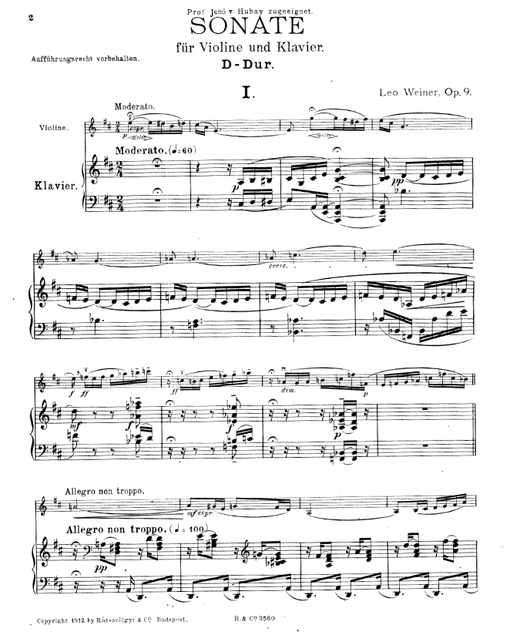
1911 as Sonata for Violin and Piano in D major, Op. 9
Orchestration between 1950 and 1958
Premiere
Delayed until 2003 in connection with a CD recording by Vilmos Szabadi
CD recordings:
Vilmos Szabadi (2003)
Júlia Pusker (2025)
Leó Weiner enjoyed rapid success even as a young composer and music teacher. As a composer, he won every prize available in Hungary at the time. At the age of 23, he became an associate
professor at the Budapest Academy of Music in 1908. As a music teacher, he trained and influenced many Hungarian musicians over the years. The Austrian knowledge network Austria-Forum counts a
whole series of well-known Hungarian musicians among his students: Géza Anda, Antal Doráti, Andor Foldes, Louis Kentner, György Kurtág, György Sebők, Georg Solti, Ede Zathureczky, Zoltán Székely,
Sándor Végh, Dénes Kovács, János Starker, Tibor Varga, the Lehner Quartet, the Magyar Quartet and the Bartók Quartet were all his students.
After initial success with his Serenade Op. 3, Weiner soon published two sonatas for violin and piano that are typical of his early compositional style: refreshing music, influenced by the
early Romantic irony of Mendelssohn, Schumann and Bizet, full of lyrical, singing melodies, but without being weighed down by heavy thoughtfulness. It is directly appealing, independent music,
influenced by Hungarian folklore, but without directly quoting it, as in the case of Kodály and Bartók. When Weiner retired from teaching and had more time on his hands, he reflected on the
concertante elements of his early works in light of new developments in European music and reworked his violin sonatas into four-movement violin concertos. Weiner regarded these concertos as
independent works in his opus catalogue, as their orchestration highlighted previously hidden qualities of the original pieces. This is how the Violin Concerto in D major was created in
1950, based on the Violin Sonata op. 9, written in 1911, which Weiner had dedicated to Jenő Hubay. However, the manuscript was not published. Since the manuscript is dated 22 May 1958, it can be
assumed that Weiner continued to work on the composition and later completed it as other works with higher opus numbers. This violin concerto thus seems to have been Leó Weiner's last completed
composition. There was no premiere during Weiner's lifetime. The premiere of this concerto did not take place until May 2003, performed by violinist Vilmos Szabadi in connection with a CD studio
recording. In the meantime, there are now further CD recordings of this refreshingly youthful violin concerto.
Listen here:
I. Moderato - Allegro non troppo
II. Allegro vivo e giocoso
III. Andante
IV. Presto
Listening companion:
I. Moderato - Allegro non Troppo
The violin begins solo with an elegant, melodious opening bow: with a long fermata on E and a descending sixteenth note movement that lands back on E an octave lower. This opening motif is
immediately repeated by the violin on G, accompanied by the orchestra. In several different attempts, the violin – hesitantly striving forward – finally leads to the introduction of the Allegro
non Troppo theme, the opening motif theme, which transforms into a melody.
The violin retunes this melody to A, as if deliberately avoiding the key's own D. The orchestral accompaniment insists all the more on the low D.
An almost spring-like romantic mood sets in. The violin develops its melody further, complemented by harp and woodwind melodies. The elegant opening motif remains present and characterises this
fantasia.
A neoclassically orchestrated pizzicato interlude and a complementary run in the low strings mark a transition to a kind of development in which the introductory motif is passed through all the
registers of the orchestra and the violin, dark and garish, tense and rhythmically urgent.
Everything strives towards a climax which, after fading away, cleverly postpones the repetition of the theme. The introductory theme reappears clearly in the orchestra. But then the violin once
again enjoys its lyrical playing, and the orchestra contributes its part to the colourful back and forth of the melodic lines that define this fantasia. However, the initial momentum
becomes increasingly calmer and finally ebbs away more and more, until in the end only the opening motif in the horn, harp sounds, a few pizzicatos and the floating away of the violin
remain.
II. Allegro vivo e giocoso
Weiner was also called the ‘Hungarian Mendelssohn’. This phrase could be associated with this dictum. It comes along at a brisk waltz tempo and slips in between the first and slow movements, as
if we were in a classical symphony. What is striking is the constant alternation between rhythmically accentuated sforzato notes and elegantly sung waltz melodies played by the violin rushing up
and down. With its rhythmic accompaniment, the orchestra imaginatively ensures that the initial drive is always beautifully maintained.
In a quieter middle section, the trio part of this enchanting piece of music, you get some time to catch your breath before the music continues to delight the listener in the repetition of the
first part. The cleverly used pizzicatos at the end also leave you with a smile on your face.
III. Andante
The Andante is mysteriously introduced by soft, sustained thirds. Above this, the melodist Weiner creates a simple, beautiful song for the solo violin. The melody unfolds its vocality in several
parts. The orchestra complements it with harmonically refined accompaniment and develops additional melodic lines to accompany the violin, which are then taken up by the orchestra.
After a rhythmically accentuated climax, the violin begins a descending cadenza twice, whereupon the flute repeats the violin's opening melody with a bright sound.
After an impressionistic interlude in the highest notes of the violin, the woodwinds interject with virtuoso runs, almost pushing the beautiful melody into the background. The wind interjections
vary their entries again and again, while the violin holds on to its song melody through various modulations until the lyrically beautiful conclusion.
IV. Presto
The orchestra and violin set a lively presto rhythm, while the wind instruments repeatedly mark a short, piquant theme. A little later, the same theme appears as a fanfare in the brass section.
Music is the art of time. The marking of time and the urgent rhythm lead to a second melodic theme in the solo violin. It is the familiar, elegant opening melody of the first movement, which
allows for a moment of calm and sings beautifully, so that even the passage of time is somewhat forgotten.
But the rhythmic élan continues to dominate and leads to the development, in which the first cheerful, piquant motif also takes on dramatic traits.
The next, somewhat calmer section is introduced by the horn and extended melodically in many colours by various orchestral instruments and the violin.
But time and rhythm continue to press forward, steering the music back towards the fanfare-like signal motif. The violin solo races on breathtakingly, accompanied by the orchestra. When the
signal motif reappears, reinforced by the timpani, sfozati in the orchestra and violin runs drive the music forward.
Once again, the forward-driving energy briefly exhausts itself, creating space for melody. A flute alternates with string runs and prepares the reprise of the second theme: the renewed return of
the opening motif as a calm violin melody. Horn sounds join in.
But this lyrical interlude is quickly replaced by a rapid waltz familiar from the second movement, which leads into a brilliant presto finale. This is followed by an effective finale for this
music, but not for real time.