
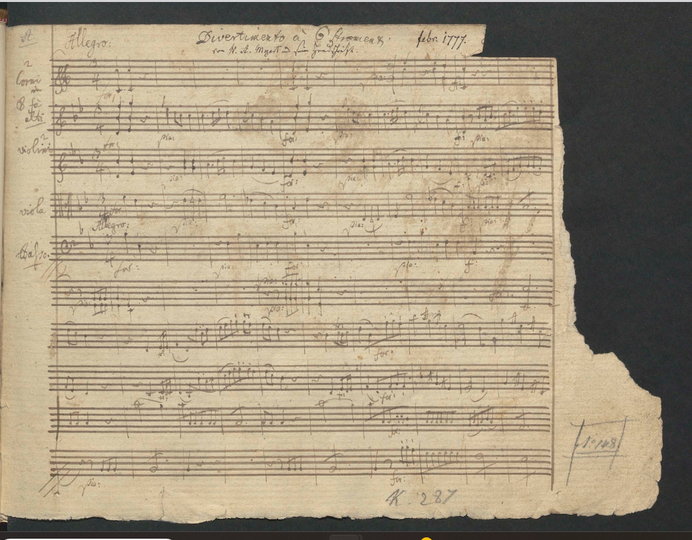
Wolfgang Amadeus Mozart: Cassation (Divertimento) in B flat major, K. 287, for violin concertante, violin II, viola, bass and two horns (1777)
Wolfgang Amadeus Mozart
Born 27 January 1756 in Salzburg Died 5 December 1791 in Vienna
First performance:
13 June 1777 (on Countess Antonia Lodron's name day) in Salzburg
Recordings:
Czech Chamber Philharmonic Orchestra Pardubice 2023
Patrick Cohën-Akenine, 2005
(Les Folies Françoises)
Kenneth Sillito, 1984 (Academy of St Martin in the Fields Chamber Ensemble)
Joseph Szigeti, 1938 (Chamber Orchestra, Max Gobermann)
Among Wolfgang Amadeus Mozart's most frequently performed concertos and solo pieces for violin and orchestra, the second Lodron Night Music – referred to by Mozart himself as ‘Cassation from
the B’ – falls between two stools. According to violinist Andrew Manze, this cassation contains ‘some of the most demanding violin parts Mozart ever wrote’. Manze added in brackets: ‘which partly
explains why so few people dare to tackle this piece today’. (Booklet accompanying Manze's CD box set The Art of the Violin)
Mozart, himself an excellent soloist in his own violin concertos and those of his composer colleagues, wrote to his father in a letter from Munich on 6 October 1777: ‘Finally, I played the
last cassation from the B by me, and everyone looked on in awe. I played as if I were the greatest violinist in all of Europe.’
Reason enough to draw attention to this violin concerto by Mozart, which, like the famous Hafner Serenade, was hidden in the light music of the time, and to arouse interest in a rarely
performed and astonishingly valuable, unknown Mozart violin concerto.
Here is some background information on the creation of this composition by Mozart:
Returning from Italy, Mozart, now twenty years old, worked as a violinist, church composer and court employee of Archbishop Hieronymus von Colloredo in Salzburg. Although he was too old to travel
with his father as a child prodigy, Leopold, as his father, violinist and author of a violin method, continued to insist that Wolfgang perfect his violin playing in order to impress Archbishop
Colloredo, who was himself an amateur violinist. Mozart was commissioned by Countess Antonia Lodron, the archbishop's sister, who was married to a count 21 years her senior and was, so to speak,
the ‘first lady’ of Salzburg, to compose the night music for her name day on 13 June 1776 and 1777. Mozart composed the cassation KV 287 immediately after the famous piano concerto KV 271, which
he wrote for the young, brilliant pianist Louise Victoire Jenamy, who had made a brief stopover in Salzburg and had greatly impressed him. She inspired Mozart to develop new ideas and
possibilities for the concert form, which led him to reinvent the piano concerto in K. 271, which in turn also influenced the cassation K. 287.
Michael Haydn, Joseph Haydn's brother, also worked in Salzburg. He was a church musician and, like Mozart, composed divertimenti for Salzburg society. A divertimento quintet by Michael Haydn is
said to have been the model for Mozart's Cassation KV 287, as Mozart researchers Théodore de Wyzewa and G. de Saint-Foix have discovered.
Under the influence of the Jenamy concerto and Michael Haydn's work, Mozart's serenade music rose to new heights. It was precisely this second Lodronian Nachtmusik, as Leopold Mozart called it in
his letters, that sparked Mozart's imagination for the solo possibilities of the concert violin, resulting in a work that went beyond the traditional forms of chamber music (by Michael Haydn),
cassations (commissioned by Countess Antonia) and concertos (new for Louise Victoire Jenamy). The fact that he also used this cassation for further performances of his own and later had it
printed in Berlin as a divertimento for six instruments (two violins, viola and bass (instead of cello) and two horns) testifies to Mozart's own appreciation of this composition.
Listen here (with accompanying score)!
Listening companion:
I. Allegro
Mozart begins with an 8-bar prelude to capture the audience's attention: two loud chords accompanied by horns and a soft, charming postlude, repeated immediately.
Only then do the violins and violas launch into the first theme, a forward-driving allegro, to which the horns immediately respond in high spirits. In three-four time, the musical interplay
between the strings and horns swings back and forth extensively until it arrives at a cadence in F and comes to a halt.
Now the concertante violin enters prominently for the first time, bringing its own dance-like second theme and then confirming its leading position with virtuoso triplet runs up to the highest
register, before stepping back again for the repetition of the exposition. Once again, we as the audience have the opportunity to follow this entertaining, swirling interplay.
In the middle section, the first violin once again takes the liberty of presenting concertante triplet virtuosity. It leads us harmoniously through light and shadow to the development of its
dance-like theme, which is contemplatively clouded and chromatically altered, supported by the sound of the horns. Recitative-like, the violin leads the development to a dramatic
conclusion.
This is followed by a repetition of the first and second themes, as in the first part. Towards the end, the solo passages of the violin rise to the high B above middle C and brilliantly add a
weighty final trill. After the final bar, Mozart ends this movement with a special coda: it is a repetition of the initial attention-grabbing prelude. As if Mozart, as a violinist, wanted to
punctuate the entire musical performance with winking eyes between exclamation marks.
II. Andante grazioso con Variazioni
Following a model by Mozart's fellow musician Michael Haydn, six variations on a simple folk song-like theme follow, introduced by the first violin and ensemble. The horns clearly mark the
transitions between the verses.
Variation 1 then offers an opportunity for a solo by the concertante violin, which plays with the theme in a rhythmically imaginative manner. Once again, the horns and the ensemble mark the ends
of the verses.
In the second variation, the violin rises, repeating the theme radiantly and thus opening up space in the lower registers for the 32nd note arabesques of the second violin and viola.
The third variation belongs to the horns. The first horn turns the opening notes of the theme into a clear signal that demands attention. At the same time, however, the solo violin shows who the
soloist is with its embellishments.
In the fourth variation, all the instruments settle into a joint tutti passage.
The fifth variation reverses the opening notes of the theme from bottom to top, thereby altering its character.
In the sixth variation, the solo violin can no longer hold back and steps forward to perform its own virtuoso violin concerto. The remaining strings accompany it with pizzicato, and only the
energetic call of the horns can stop the violin and this movement.
III. Menuetto
In Salzburg, dancing in the form of minuets was part of a night-time entertainment concert under the open sky. This first minuet begins with the light rhythm of an allemande and invites the
audience to dance calmly.
The trio is enchanting: Mozart's solo violin shifts ascendingly to G minor, and as always with Mozart, G minor is a very personal key, which here breaks into the festive gathering like a
momentary contemplative interlude. The communal dance takes on a new, mysterious dimension.
IV. Adagio
The violin now continues to sing in a meditative solo, building on the mood already established in the trio of the minuet. The horns remain silent. As in the slow movements of his violin concertos from 1775 and 1776, Mozart composes an indescribably beautiful melody in E flat major. One could simply listen to Mozart forever. It is a dreamy aria without words that Mozart plays on the violin. Discreetly accompanied by the other instruments, the deep pizzicatos of the double bass are particularly beautiful. The second violin and viola join in from time to time, inviting the music to continue, making one forget the passing of time. The violin always finds the beginnings of a new melody and only leaves its magical world at the end in a free cadence over a pedal point. And quietly, the nocturnal music sinks into the darkness.
Listening to this adagio several times, one discovers the underlying temporal structure that Mozart designed for this song. A first theme, repeated three times, is replaced after a wonderfully
expansive cadence by a second theme on the violin, which lingers long on the note G. After its repetition by the entire ensemble, a concertante ending to the exposition follows, which is to be
repeated.
The development changes the first theme in its harmonic progression and descends into faltering sighing figures. Beginning a second time, Mozart improvises this theme again in a free-flowing manner and then omits the actual reprise of the first theme.
Only with the fading transition does he turn directly into the reprise of the second theme. After its repetition in the ensemble, Mozart drives the solo violin to virtuoso heights and through self-assured coloraturas. Only after the cadenza in the coda does the violin sink back into the quiet evening and release the listeners once again to the ballroom dance.
V. Menuetto
The horns call for dancing, the strings cleverly form the echo. The solo violin dances along. A brief minor key cloud hardly disturbs the dancers' movements.
In the trio, the concertante violin once again takes the lead and surprises with a lively bow in a kind of country dance. The horns remain silent until they signal again in the repetition of the
first part.
VI. Andante - Allegro molto
The finale surprises right at the beginning with an operatic recitative. The concertante violin is accompanied with great solemnity by the rest of the ensemble (Mozart had already included a
similar recitative passage in the Jenamy Concerto). The fact that this solemn, almost tragic recitative ends in G minor is reminiscent of the trio of the first minuet and the moods in the adagio.
Shadows appear in the midst of festive life. Or did the pathos simply serve the purpose of concertante self-expression?
All the more surprising is the contrasting lively allegro in B flat major that follows. It begins rhythmically and humorously with the folk song theme ‘D' Bäurin hat d'Katz verlorn, weiss nit,
wo's ist’ (The farmer's wife has lost her cat, doesn't know where it is). A ritornello solo by the concertante violin leads to the dance-like second theme. This is also followed by a longer
ritornello dominated by virtuoso solo runs, which leads into another melody concluding the exposition.
The return of the folk song theme opens a longer development with a new rocking theme that gives the solo violin the opportunity to soar to the highest registers. Brilliant violin playing then
leads back to the reprise of the folk song theme and the second theme, analogous to the exposition.
Then comes a surprise: the opening recitative of the solo violin returns, somewhat shortened and modified, a moment of tension in which the concert violinist Mozart presents himself for the last
time with a dramatic tone that is no longer entirely serious. But then, for a brilliant finale, the folk song theme returns, performed with wit, charm and effect: ‘Everyone looked on in
awe. I played as if I were the greatest violinist in all of Europe’ (Mozart).