
Joey Roukens: Violin Concerto «Out of the Deep” (2024)
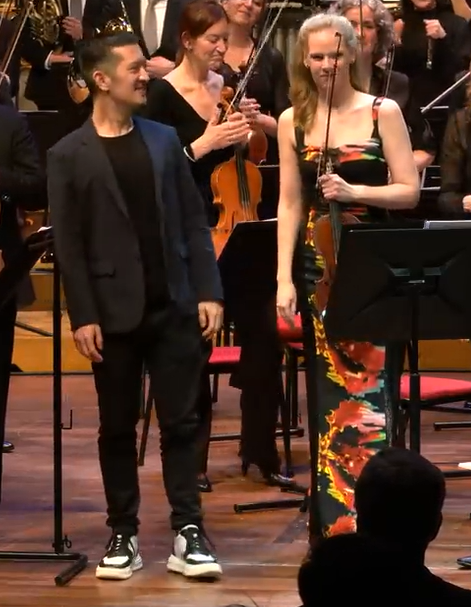
Joey Roukens
born 28 March 1982 in Schiedam (Netherlands)
World premiere:
31 January 2025, performed by Simone Lamsma and the Netherlands Radio Philharmonic Orchestra, conducted by Markus Stenz
Recording:
2025 Simone Lamsma on YouTube
Can we really speak of a new trend in contemporary violin concertos? If a ‘trend’ refers to something new within the new, then I can most readily associate the term ‘new trend’ with the two
violin concertos by the Dutch composer Joey Roukens.
Even in his first violin concerto, ‘Roads to Everywhere’, one is struck by the blend of the most diverse musical styles, which are incorporated into so-called contemporary music in a
postmodern manner – existing side by side and intertwining – and creatively realised with artistic ambition. These diverse musical ‘roads’ – drawing on pop, jazz, film music, traditional and
modern classical music, and so on – can be subsumed into a new ‘Everywhere’ through a fresh artistic vision. In Roukens’ own words, it sounds like this:
“I compose vivid, eclectic music. My aim is to create expressively rich works out of simple materials from both tradition and pop culture.”
In the Second Violin Concerto highlighted here, the key to the artistic treatment is also expressed
in the title: ‘Out of the deep!’. Roukens says of this:
“While writing the piece I often had the image in my mind of a music trying to escape from the depths. Moreover, the concerto had a difficult birth, as if it had to come from deep
within…”
This question – both compositional and existential – of how music escapes from the dark depths, and how one can existentially endure in the face of the destructive dark depths of our sense of
time, remains unresolved until the very end of the piece. The violin concerto remains a struggle with feelings of powerlessness in the face of the unresolved future of our artistic and global
situation. Roukens himself says of his Second Violin Concerto:
«It is one of the darkest and most sombre pieces I have written.”
The concerto breaks with the traditional three-movement structure and is written as a through-composed whole, with thematically designated subsections that flow into one another without
interruption.
Listen here!
Listening companion:
I. Rage and Lament
An angry, percussive, two-bar orchestral motif repeatedly assails the unsuspecting audience fortissimo. In between, deep wind sounds and string runs rumble. The orchestra only gradually calms
down, with the bassoons and trombones lingering in an abysmal resonance.
Above ‘this abyss of deep, dark sounds’, the ‘solo violin emerges with a plaintive motif in its lowest registers’ – so writes Rouken in a description of the work. He continues:
‘From this starting point, the soloist embarks on a journey that ultimately ends in the very highest register of the violin in the final bars of the epilogue.’
When the violin – accompanied by strings and harps – first reaches its upper registers and then swings back downwards, it is interrupted by the orchestra, which bursts in with fierce intensity
(agitato e rigoroso!). The fury rages, then freezes in a long bass note dominated by the trombones.
Whilst the violin continues its lament, based on a simple, barcarolle-like theme in 6/8 time, the orchestra – diversified into a variety of sounds and rhythms – accompanies it restrainedly. One
senses an intensification of the music in both the violin and the orchestra. The violin builds ever more intensely into passages of double stops.
After the solo violin has reached its high G and holds it intensely, a rising solo horn melody – emerging from the orchestra and accompanied by forceful timpani beats – propels the orchestra
towards an overwhelming final fortissimo.
II. In Flux
After the break, the orchestra immediately takes the lead once more. The orchestra leads the way with a rhythmically dynamic theme in the trumpets, violas and timpani, yet the solo violin plunges
into the same flow of energy with its eighth notes, played with almost metronomic precision.
This flow continues with virtuosity and colour over a long stretch, always full of power and in a pop-style 4/4 time. Individual gestural interjections and snippets of melody appear and
disappear in the back-and-forth between solo and orchestra without any loss of energy or rhythm, whilst the music is constantly evolving with ever-changing momentum.
A virtuoso final spurt from the solo violin brings this burst of energy to a close, ending on a solitary yet passionate high note on the violin.
III. Sanctuary
In stark contrast to the previous section, the orchestra launches into a solemn tutti led by the brass section, which is shortly afterwards replaced by a calm, lyrical interlude. The
barcarolle-like theme reappears in the English horn, is taken up by the solo violin, and is developed with increasing vigour and passion against the orchestra’s spirited accompaniment.
Finally, the horns emerge from the background and carry the melody forward with rich tone, whilst the violin continues to weave its figurations. Two clarinet glissandi interrupt the lyrical mood,
to which the violin responds with virtuoso tremolos, restoring calm once more.
Finally, the violin leads into a fortissimo orchestral tutti, rhythmically driven by the drum, followed by an energetic solo cadenza on the violin.
Virtuoso, almost furious solo figurations at the beginning subside, and after a piercing note from the harp and piano, the solo violin – softly accompanied by the strings – strikes up a sort of
Bach-like chorale with its double stops, expressing reverence. At first, only soft timpani rolls and tremolos from the solo violin build in intensity and lead into the next section
iV. Upsurge
Just as at the beginning, the two-bar percussive orchestral motif, complete with its distinctive trumpet fanfares, once again takes the audience by assault.
The strings and woodwinds begin with rapid figures and mark a fresh start with renewed vigour. The solo violin, too, begins with renewed energy and its rapid eighth-note figures.
The solo violin and orchestral interjections alternate in a concertante, contentious back-and-forth. ‘Finally’ – as Roukens notes in his commentary on this section – ‘the vehement energy with
which the piece began returns: the solo violin and orchestra seem to be locked in an increasingly intense dispute, which lends the music a certain tenacity or even anger. This culminates in a
powerful outburst from the orchestra’.
V. EpilogUe
The intense, percussive orchestral motif comes to an abrupt halt. As its faint reverberations fade, final bursts of energy still explode, before dark, deep sounds take over once more.
With the entry of the solo violin, a new quest ‘Out of the Deep’ begins; this time, however, not in anger, but in a meditative epilogue.
The solo violin rises once more from deep tones into an aesthetically contemplative melody – accompanied by orchestral instruments such as the strings, and finally the piccolo and the bell –
soaring into its highest registers before fading softly at the very top, as if resigned.